Stargazing in Tekapo: New Zealand's Most Accessible Dark Sky Sanctuary
Produced with AI assistance. Reviewed by Equipe PaceRoam. · Updated October 27, 2026
Lake Tekapo sits inside the Aoraki Mackenzie International Dark Sky Reserve, the largest Gold-tier reserve of its kind in the world, covering roughly 4,300 km² where outdoor lighting is legally regulated to protect night-sky darkness. The village itself has a population of about 500 and sits roughly three hours by road from both Christchurch and Queenstown (or about two hours from Queenstown via the Lindis Pass). Based on 2026 research, here's the most affordable way to actually see Tekapo's sky without owning astrophotography gear.
Getting there
There's no meaningful public transport into the Mackenzie Basin — a rental car is close to mandatory. From Christchurch, the usual route runs via State Highway 1 then State Highway 8, about three hours covering 225 km. From Queenstown, the more scenic drive goes over the Lindis Pass and takes closer to two hours.
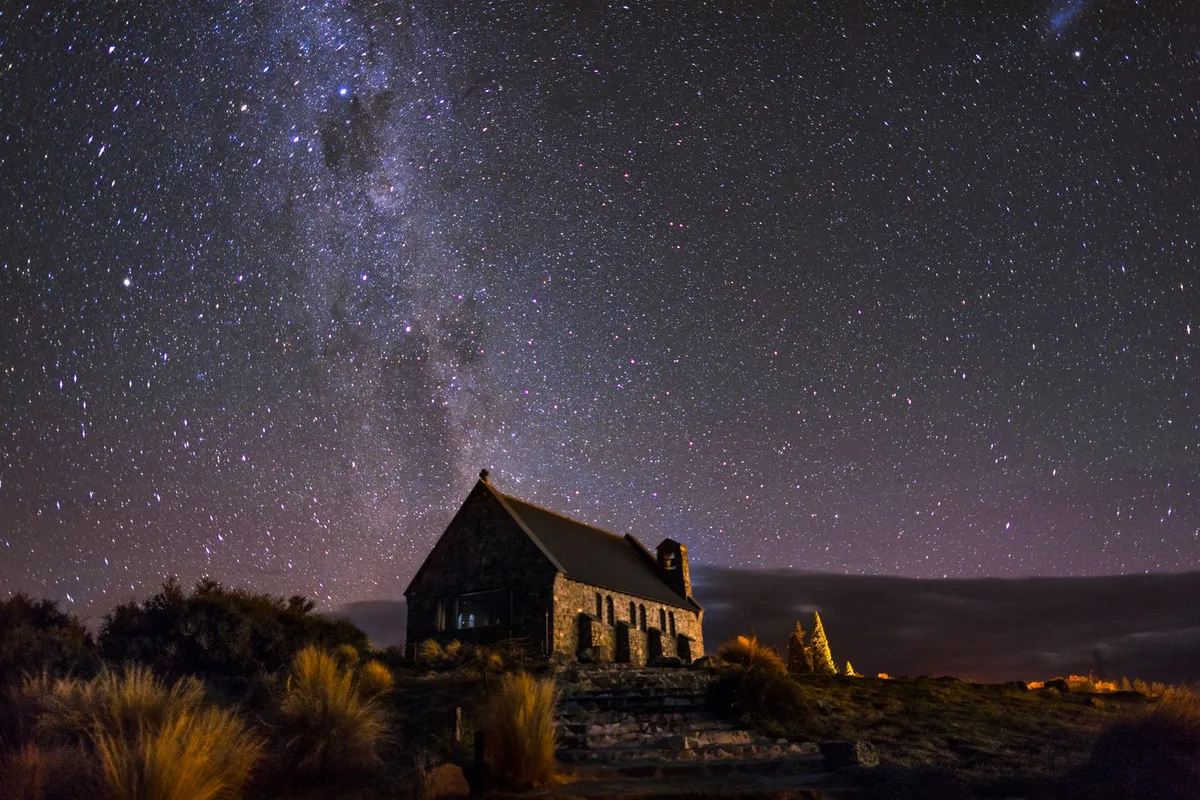
The free option: the Church of the Good Shepherd
Built from local stone in 1935, the Church of the Good Shepherd is New Zealand's most photographed building and sits on the lakeshore a few minutes' walk from the village center. By day it's a busy tourist stop; by night, with the lake and the Milky Way behind it, it's the classic foreground for anyone shooting Tekapo's sky without booking a tour. Access to the lakefront and the church grounds is free.
Going up to Mount John Observatory with a guide
For a look through an actual research telescope, Dark Sky Project runs the "Summit Experience" at the University of Canterbury's Mount John Observatory, 1,029 m above the lake. The tour runs 1h45, includes transport, guiding, and cold-weather jackets, and costs NZ$219 per adult under the rate card valid through September 30, 2026. Cheaper alternatives from local operators run NZ$70 to NZ$128, offering naked-eye stargazing and smaller ground-level telescopes without summit access.
The free trail to the same summit
For travelers who'd rather skip the observatory ticket and still reach the top, the Mount John Walkway is an 8.9 km loop, about three hours on foot, ending at a 360-degree viewing platform on the same 1,031 m summit where the observatory sits — no entry fee, though it doesn't get you inside the building or access to the university's telescopes.
Best season for clear skies
Tourism New Zealand cites April to September as the best window for clear nights in the region. The reserve's darkness holds year-round, but cloud probability climbs outside that window.
Is it worth the budget?
One night in Tekapo — basic lodging, a rental car split across the group, and a free walk to the Church of the Good Shepherd after dark — already delivers the reserve's sky at zero activity cost. For the guided Mount John summit experience, NZ$219 per person is the fair price for standing inside a working research observatory; a NZ$70-80 alternative covers the same dark-sky reserve, just at ground level.
What to pack and when to go
Nights in the Mackenzie Basin cool down fast even in the southern summer — pack a windbreaker beyond whatever the guided tour lends you, since the free Mount John Walkway doesn't come with any gear. For long-exposure photography, a steady tripod matters more than an expensive lens: the reserve's darkness does most of the work, and a 15 to 25-second exposure at a moderate ISO is usually enough to pull the Milky Way out over the lake.
Full moon changes everything
As with any dark-sky reserve, the moon phase decides whether the Milky Way shows up crisp or washes out in moonlight. Before booking any tour, check the lunar calendar and aim for nights close to the new moon — that's when the contrast between the galaxy's arc and the surrounding sky becomes far more visible, both to the naked eye and in long-exposure shots. Checking moonrise and moonset times the same evening also helps: even during a brighter phase, a window after moonset can still deliver a dark enough sky for a usable shot.